
Join Low Voltage Nation — Find project opportunities and showcase your company to thousands of industry professionals
DOE selected Brookfield to develop an AI data center campus on 3,556 acres of the former Paducah Gaseous Diffusion Plant in Kentucky, with NextEra building up to 2 GW of gas generation and 2.6 GW of battery storage. Eleven low voltage systems and an estimated $600 million in LV work across 1.2 GW of compute — with no tenant named and nothing awarded on the construction side.
The Department of Energy is converting a Cold War uranium enrichment plant in western Kentucky into a $100 billion AI data center and energy campus. Eleven low voltage systems, an estimated $600 million in LV work across 1.2 gigawatts of compute — and no tenant has been named.
Project Overview
Project data shows DOE has selected Brookfield Asset Management to develop and operate an AI data center campus on portions of the former Paducah Gaseous Diffusion Plant in Paducah, Kentucky, with NextEra Energy building and owning the supporting power infrastructure. Reporting places the privately funded framework above $100 billion.
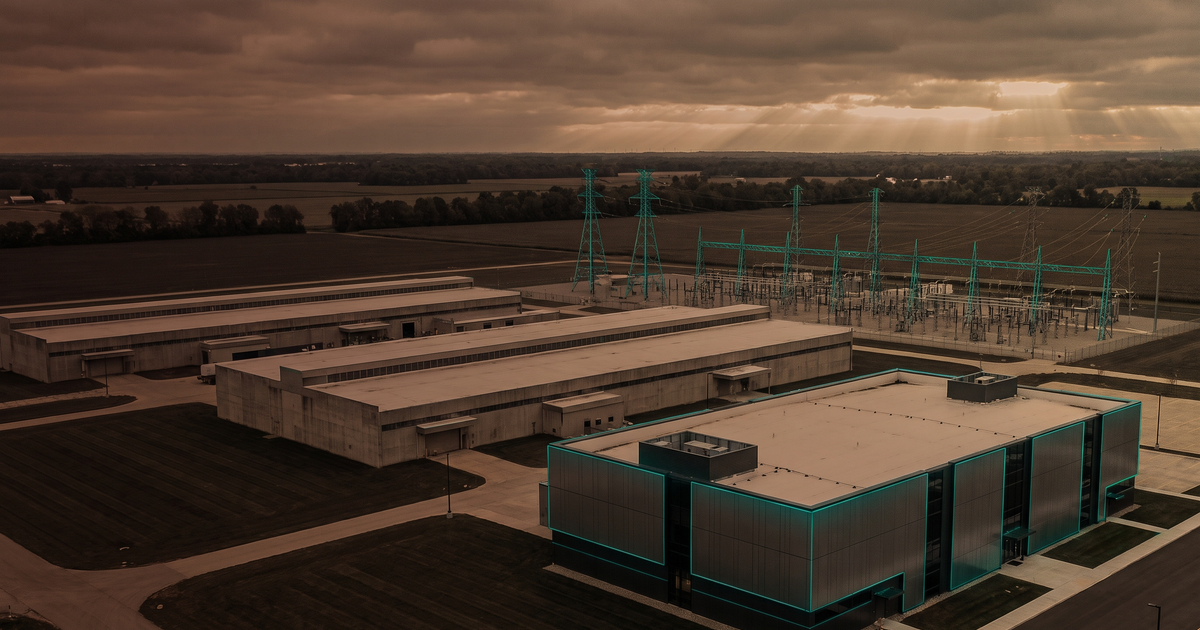
The site is 3,556 acres carrying more than 500 existing structures. DOE describes a campus supporting up to 1.8 GW of utility capacity and more than 1.2 GW of computing capacity. NextEra will develop up to 2 GW of natural gas generation and as much as 2.6 GW of battery storage at or near the campus — grid-connected rather than behind-the-meter, with stated capacity exceeding the campus's own needs so surplus can be delivered to the regional grid.
Initial operations are expected around 2028, construction completion in 2031, and full buildout in 2032. The development is projected to create roughly 8,000 construction jobs and 600 permanent operations positions. Power delivery runs through Big Rivers Electric Corporation for wholesale service and Jackson Purchase Energy Cooperative for retail delivery, with Paducah Power System as a community partner. The power service agreement requires Kentucky Public Service Commission approval.
| Project | Paducah AI Data Center & Energy Campus |
| Location | Former Paducah Gaseous Diffusion Plant, Paducah, KY |
| Investment Framework | More than $100 billion (privately funded) |
| Site | 3,556 acres, 500+ existing structures |
| Compute Capacity | More than 1.2 GW (1.8 GW utility capacity) |
| Dedicated Generation | Up to 2 GW gas + up to 2.6 GW battery storage |
| Developer / Operator | Brookfield Asset Management |
| Timeline | Initial ops ~2028, construction complete 2031, full buildout 2032 |
| LV Score | 10/10 |
The Power Is the Product
Most large data center projects follow a familiar order: a tenant commits, a site is chosen, and then everyone spends two years fighting for an interconnection. LVN covered the failure mode of that sequence recently in Santa Clara, where finished buildings sit dark because the utility ran out of headroom.
Paducah inverts it. Roughly 4.6 gigawatts of dedicated generation and storage is being built for a campus that has no announced tenant. The power is not a constraint being solved after the fact — it is the thing being sold.
The site won for exactly that reason. A gaseous diffusion plant consumed staggering amounts of electricity, so the parcel already carries heavy transmission capacity, an on-site water treatment plant, fiber connectivity, and road access. DOE effectively had a pre-industrialized, pre-powered, pre-plumbed 3,556-acre parcel sitting idle. In 2026 that combination is worth more than the land.
For contractors the read is straightforward. Power availability is the single best predictor of whether a data center project will actually be built, energized, and closed out. A campus with 4.6 GW committed and a decade-long buildout is about as durable a pipeline as this sector produces, even before a tenant signs.
The Site Is a Federal Cleanup Reservation
This is not a greenfield. The Paducah Gaseous Diffusion Plant began enriching uranium in 1952, supplied the weapons program and later commercial nuclear fuel, ceased commercial enrichment in May 2013, and was returned to DOE's Office of Environmental Management on October 21, 2014 for deactivation, decontamination, and cleanup. That work is ongoing.
DOE-EM issued its Request for Offers on November 4, 2025 with responses due January 30, 2026, using authorities under the Atomic Energy Act of 1954 and the 1993 Hall Amendment. The solicitation is for solely funded projects in which the applicant is responsible for building, operating, and decommissioning.
That history changes the job in ways worth pricing:
- Federal site access. Badging, escort protocols, and personnel screening on a DOE reservation are not the same as a contractor gate at a private campus. Onboarding time is real and it is not billable.
- Radiological awareness training. Crews working anywhere near legacy areas will carry site-specific training requirements, and potentially dosimetry depending on where the work falls.
- Coordination with an active D&D program. Deactivation and decontamination is still running. New construction sequencing has to work around it, and buried-utility assumptions on a 1950s industrial site should be treated as unknown until proven.
- 500+ existing structures. Some will be demolished, some reused. Reuse on a legacy nuclear industrial building brings survey, abatement, and documentation obligations before a single cable tray goes up.
None of this is a reason to avoid the project. It is a reason that the qualified bidder list will be shorter than a $100 billion headline suggests — which is the whole point for a contractor deciding where to spend business development effort.
Low Voltage Systems Breakdown
Signal tracks eleven low voltage systems here — the full hyperscale stack, delivered in phases against compute ramps rather than as one award.
| System | Category | Scope Description | Complexity |
|---|---|---|---|
| Fiber | Data | Single-mode backbone within and between data halls, MPO/MTP trunk architecture, high-density patching sized for AI east-west traffic. At gigawatt scale the splice count is in the hundreds of thousands across the program. | Very High |
| Outside Plant | Data | Campus duct bank, handholes and vaults, carrier entrance, and diverse-path routing across 3,556 acres. Existing fiber connectivity is an advantage; 1950s buried infrastructure of unknown provenance is a risk. Potholing and survey budgets should be generous. | Very High |
| Structured Cabling | Data/Voice | Horizontal and backbone copper, cabinet patching, overhead pathway and ladder rack across every data hall plus admin and operations space. A production-labor package where crew depth determines whether you hold schedule across a decade-long ramp. | High |
| Access Control | Security | Layered perimeter-to-hall credentialing on a site that already carries federal access controls. Expect integration between the campus system and DOE site protocols, plus separate treatment for generation and storage assets. | Very High |
| CCTV | Security | Perimeter, yard, substation and generation approach, entry, corridor, and data hall coverage with long retention. Perimeter alone is substantial on a parcel this size. | High |
| Fire Alarm | Life Safety | Addressable detection with very early warning aspirating smoke detection in data halls, integrated with clean-agent or pre-action release and the electrical and mechanical shutdown matrix. Kentucky AHJ coordination on a first-of-kind local facility adds review time. | Very High |
| BMS / Controls | Building Automation | Cooling plant control, containment and thermal monitoring, and EPMS integration across data halls — plus interface points with generation and storage assets that are owned and operated by a different party. That ownership split is a real integration boundary. | Very High |
| Networking | Data | Facility, OT, and security network infrastructure separate from the compute fabric. On a campus with on-site generation, OT segmentation between data center systems and power assets is a design requirement, not an afterthought. | High |
| DAS | Wireless | In-building cellular across very large structures plus public safety radio coverage. On a 3,556-acre site with legacy industrial buildings, outdoor coverage for operations and emergency response is its own problem. | Medium-High |
| Grounding & Bonding | Infrastructure | Signal reference and telecom bonding backbone, ground rings, cabinet and pathway bonding to IEEE and BICSI practice, coordinated with substation and generation grounding. Legacy site grounding infrastructure must be verified, never assumed. | High |
| Commissioning | Validation | Levels 1 through 5 including integrated systems testing across phased buildings, with the added wrinkle that power sources are owned by a separate entity. Pull-the-plug scenarios require coordination across two organizations. | Very High |
Estimated Low Voltage Value — and Why Not to Use the $100 Billion
This project is a good example of why headline numbers need to be handled carefully.
Do not apply a percentage to $100 billion. That framework covers the data center campus, roughly 4.6 GW of gas generation and battery storage, transmission upgrades, and a decade of program cost. Gas turbines and battery containers do not contain data halls. A 4% rule applied to the headline would produce a $4 billion low voltage figure that is wrong by roughly an order of magnitude.
The number that actually predicts low voltage scope is compute capacity. Here that is more than 1.2 GW.
| Compute Capacity | 1,200+ MW |
| LV per MW of IT capacity | approximately $500,000 |
| Estimated LV Contract Value | approximately $600 million |
| Planning Range | $480 million – $840 million ($400K–$700K per MW) |
That per-megawatt figure is not invented. LVN's spotlight on Microsoft's Alviso campus in San Jose covered a 48 MW facility with an estimated $28.9 million low voltage value — roughly $602,000 per MW. Paducah should land below that on a per-MW basis because repeated building designs and enormous purchase volumes drive unit costs down at campus scale, so $500,000 per MW is the reasonable planning anchor.
Spread across a buildout running to 2032, that is roughly $60 million to $85 million of low voltage work per year at steady state, split across eleven system packages and multiple buildings. Individual awards will look like normal projects. The program behind them will not.
Skills and Certifications Required
| System | Key Certifications | Critical Skills |
|---|---|---|
| Fiber & Outside Plant | BICSI INSTF, BICSI OSP, FOA CFOT/CFOS, BICSI RCDD | Mass fusion splicing, MPO/MTP polarity management, OTDR and Tier 2 testing, duct bank design across a large legacy industrial site |
| Structured Cabling | BICSI RCDD, BICSI DCDC, INSTC, manufacturer certification | High-volume production installation, pathway and containment design, Fluke certification at scale, as-built discipline over a decade |
| Fire Alarm | NICET Fire Alarm Level III+, Kentucky licensing | VESDA and aspirating detection, clean-agent and pre-action release logic, NFPA 72, shutdown matrices, AHJ coordination |
| Access Control & CCTV | ASIS PSP, manufacturer certification (Genetec, Lenel, Software House, Axis) | Multi-layer credentialing, integration with federal site access protocols, large-scale VMS architecture, long-retention storage design |
| BMS / Controls & Networking | Tridium Niagara N4, BACnet, IEC 62443 for OT security | Cooling sequences, EPMS integration, OT segmentation between data center and generation assets, cross-owner interface management |
| Commissioning | ACP/CxA credentials, BICSI/IEEE bonding practice | Level 4-5 integrated systems testing, scripted failure scenarios across two owner organizations, legacy grounding verification |
Two site-specific qualifications matter more than any certification listed above: DOE site access eligibility and radiological worker awareness training. Contractors who already hold DOE or NNSA site experience — of which Kentucky, Tennessee, and southern Ohio have a real supply, given Paducah, Portsmouth, and Oak Ridge — start this race well ahead of a data center specialist flying in from Dallas.
Market Signal
Paducah is the second former gaseous diffusion plant LVN has tracked being converted to AI infrastructure. The other is SB Energy and SoftBank's PORTS Technology Campus at the former Portsmouth plant in Piketon, Ohio. Two DOE enrichment sites, two multi-gigawatt AI campuses, same underlying logic: enormous legacy electrical service, industrial land nobody else wants, and a federal owner motivated to find a productive use.
That is now a pattern worth watching rather than a coincidence. The United States has a finite inventory of heavily powered, federally held industrial sites, and the AI buildout has discovered them. Contractors in the Ohio River Valley — western Kentucky, southern Ohio, southern Indiana, east Tennessee — are sitting in the middle of it, and it is a region that has spent decades losing industrial employment rather than gaining it.
The practical read: this is a decade-long program on a site with the qualifications barrier already built in. Get DOE site-access experience on the books, get qualified with Brookfield's development organization before a construction manager is named, and understand that the shortlist for a federally sited nuclear-legacy campus will never be as crowded as the dollar figure implies.
Find Projects Like This on Signal
LVN Signal tracks thousands of construction projects with low voltage opportunities across the country. Filter by city, system type, and project value to find your next bid.
Join 35,000+ Low Voltage Pros
Get weekly permit updates, tool deals, job opportunities, and industry news. No spam, unsubscribe anytime.